
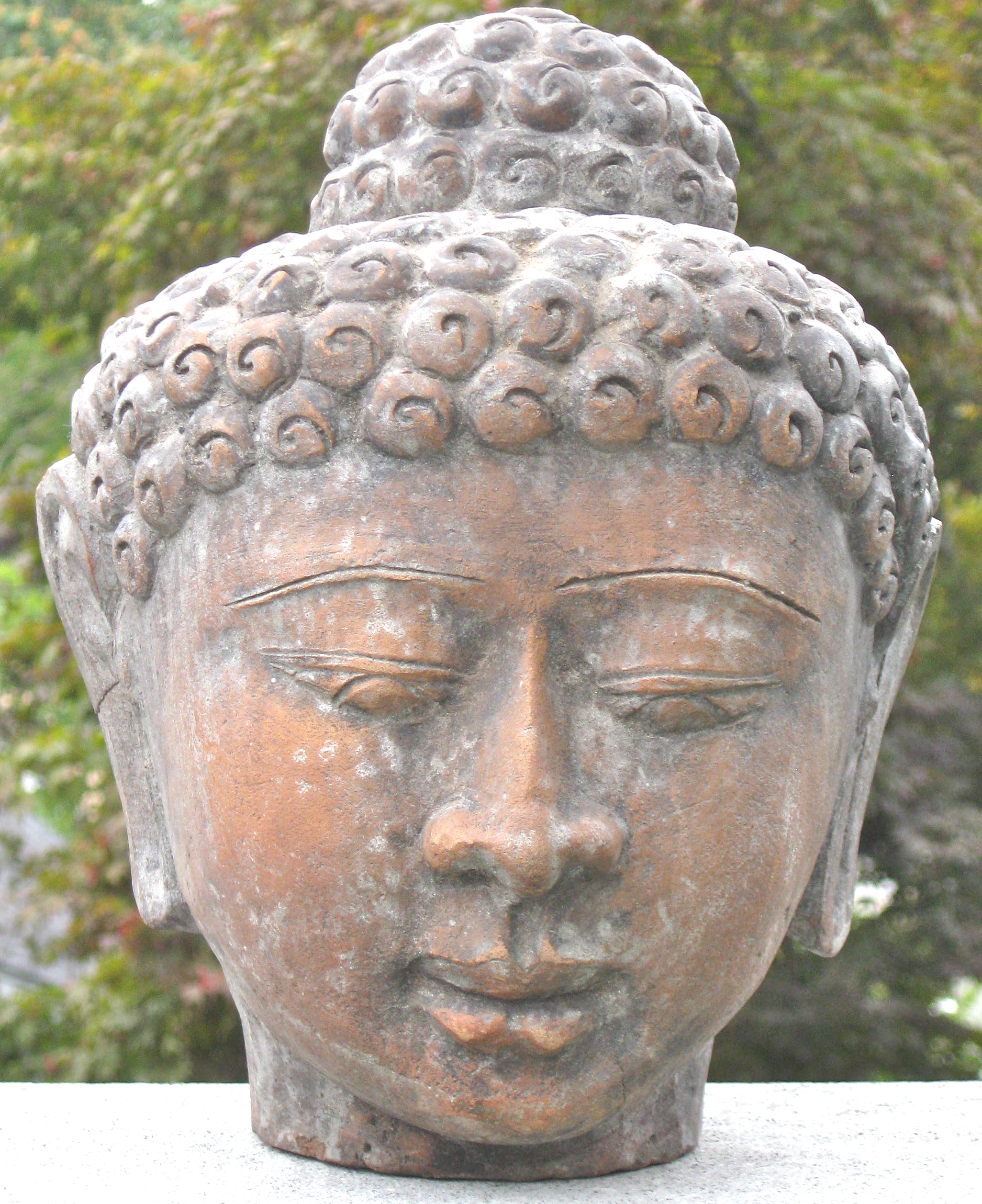
We want our Buddhist practice to be “authentic” in two different senses of the word: First, we want it to be authentically Buddhist—a genuine part of the current of thought originating with the life and teachings of the historical Buddha and remaining, in important senses, faithful to it. Second, we want our practice to be authentic in the sense that we can practice it wholeheartedly without inner division, false consciousness, or pretense. We want it to be consonant both with our present understanding of ourselves and the world, and with our aspirations to transcend our present capabilities and understandings in ways that lead to higher levels of well-being. The first “authenticity” is about faithfulness to a tradition; the second about faithfulness to current and future visions of ourselves. Unfortunately, what it means to be faithful is rarely simple or straightforward—neither “traditions” nor “selves” are static entities—they continuously evolve and are subject to reinterpretation. In addition, there are dialectical tensions between the two kinds of authenticity—being true to a tradition and to oneself— and they are not always in harmony.
The question — “Is this the Buddhism of our ancestors?” — is a perennial one. Every Buddhist school makes claims to its authenticity, often playing fast and loose with history to prove its point, but every successful Buddhist movement to claim or restore an idealized past inevitably ends by re-creating a new Buddhism for its time and place. These Buddhisms can’t help but reflect the consciousness of the historical era in which they are “rediscovered.” If, by some miracle, they resisted contamination by the Zeitgeist, they’d be of no value to their practitioners who, prisoners of their own time, are incapable of turning back consciousness and authentically inhabiting another one. This is a function of the second type of “authenticity”—one’s ability to fully inhabit and embody a practice.
The effort to rediscover the “real” Buddhism is a recurrent theme in Buddhist history. Buddhism is always being lost and rediscovered, but each rediscovery is never the restoration of something old, but a reinvention relevant to its place and time. In our present day, Stephen Batchelor—a person I otherwise agree with on most particulars—at times seems to think one can recover a pre-Theravada Buddha who never believed in rebirth. All that rebirth stuff, he seems to be saying, got tacked on later. Of course there is no way of knowing for certain—we know next to nothing about the historical Buddha. But why re-create a Buddha who is “just like us”—why not leave him a prisoner of his own time and place in the same way we are prisoners of ours? If we can recognize Plato was mistaken on some matters but still appreciate his central importance to Western philosophy, why can’t do the same when it comes to the Buddha?
Authenticity and Theravada
Theravada Buddhists sometimes claim their tradition represents the “most authentic” form of Buddhism. Theravada, as such, did not exist during the Buddha’s lifetime, however, and there were multiple pre-Theravada Buddhist schools that evolved in the centuries following the Buddha’s death. Theravada emerged from one branch of these schools—Sthaviravada-Vibhajivada—between 200 and 100 BCE. It developed its own commentarial tradition in Sri Lanka in relative isolation from later developments (Madhyamaka, Yogacara, Tathagatagarbha, Tantra) on the Indian subcontinent or in Gandhara.
Theravada views these later mainland developments as corruptions of the Buddha’s authentic teachings. This reflects, in part, the assumption that only the founding teacher gets to define a tradition and that later interpreters and elaborators should be viewed with suspicion. This makes sense if the founding teacher is omniscient and infallible and the canonical record of his teachings is accurate and complete. But what if one views the Buddha as an extraordinarily wise teacher, but still just a fallible human being? Then the argument doesn’t work. It would be like arguing that authentic Western philosophy ended with Plato and we shouldn’t bother with Aristotle, Spinoza, Hume, Descartes, Kant, Hegel, Nietzsche, Dewey, or Wittgenstein; or that authentic Confucianism ended with the Analects, and we should ignore Mencius, Xunzi, and Zhu Xi. Why freeze a tradition in amber when it is just getting underway?
The Theravada claim that its practices and teachings are identical to the original Buddha’s also doesn’t withstand analysis. A good deal of current Theravada teaching is derived from Asian Buddhist modernist movements in Sri Lanka, Thailand, and Burma. The meditation methods of Mahāsī Sayadaw and Ajahn Chah are reinterpretations of traditional practices developed in the wake of Ledi Sayadaw’s (1846-1923) vipassana revival. Ledi Sayadaw taught a form of meditation the laity could practice without mastering the jhanas. Braun (2018) wrote while his method could be found in canonical texts, “it had been considered less than ideal and was little taught. Suddenly, it became the norm.” Modern vipassana also differs from the esoteric Southeast Asian Boran Kammatthana form of meditation that immediately preceded it in much of Southeast Asia. The point is, Theravada is a living tradition, and every teacher introduces innovations in how it is taught and practiced—the methods taught by Ajahns Chah, Maha Bua, and Buddhadasa were distinctively different. It is not an unchanging teaching. This is how it should be—unless you believe there is only one right way to do things and one size fits all.
The claim Theravada Buddhists can make is that the Pali canon, as transcribed in Sri Lanka in the first century BCE, contains the earliest distillations of the orally transmitted teachings of the Buddha. On the other hand, not all the over 10,000 suttas in the Pāli Nikayas were composed during or shortly after the Buddha’s lifetime—there are scholarly reasons to believe the corpus gradually expanded in the centuries following his death. Some suttas read as if they might be accurately reported discourses of the Buddha, but others—like the tales of interactions with mythological devas, brahmas and yakkhhas in the Samyutta Nikaya—seem more like literary inventions. In addition, there may be a few Pali suttas that were composed contemporaneously with—or even later than—the earliest Mahayana sutras. The oldest surviving ancient Buddhist manuscript is a Gandhari Prajnaparamita text carbon dated to between 84 BCE and 74 CE—the same general era when the Pali suttas were first committed to writing in Sri Lanka. While most Pali suttas are certainly older than most Mahayana sutras, perhaps not all are.
Authenticity and Mahayana
As new sutras made their appearance in India and China from 100 BCE on, Mahayanists felt the need to justify their authenticity as buddhavacana, or the “word of the Buddha.” Many gambits were tried to “establish” their provenance. Sutras might be declared “hidden” or “secret” teachings entrusted only to the Buddha’s wisest disciples; or they might be claimed to have been rescued by Nagarjuna from mythological serpents at the bottom of the sea; or it might be claimed that when the Buddha spoke, students with different capacities heard different teachings; or it might be claimed the sutras were uttered by a Sambhogakaya Buddha while the hearer was in a state of samadhi. None of these Mahayana gambits sound convincing to modern ears, and scholars generally accept that the Mahayana sutras are not the words of the historical Buddha in the same way at least some Theravada suttas probably are.
But the question of whether the historical Buddha actually spoke the words may not be the most important one. It may be more important that innovative teachings be consistent with the overall intentions of the Buddhist project and help people make better sense of their practice. Innovations such as Madhyamaka “emptiness,” Yogacara “storehouse consciousness,” Tathagatagarbha “buddha-nature,” the Huayan imagery of “Indra’s Web,” or the Lotus Sutra’s “skillful means” can solve problems in Buddhist theory or introduce new possibilities for Buddhist practice. It is up to each practitioner to decide whether these innovations are improvements on earlier understandings or impediments to practice and awakening.
Influence, Change, Return, and Reinvention
As the Buddhist tradition was transmitted via the Silk Road to China and Tibet and eastward to Korea and Japan, it underwent another series of transformations. Chinese Buddhism was influenced by Daoist and Confucian thought, and Tibetan and Japanese Buddhism by local indigenous beliefs. As Buddhism moved West, it was influenced by romanticism, transcendentalism, existentialism, phenomenology, the European enlightenment, psychoanalytic and humanistic psychology, the Judeo-Christian tradition, neuroscience, and a variety of other influences.
There is no shortage of critics who view the Sinification of Indian Buddhism, the Japanification of Chinese Buddhism, and the Westernization of American Buddhism as historical mistakes. Piya Tan (2009) rues the Sinification of Indian Buddhism, Chuan Zhi (2019) the Japanese corruption of Chinese Zen, and Thanisarro Bhikkhu (2012) the corrupting influence of German Romanticism on contemporary Western Buddhism. There is a recurrent wish in Buddhist circles for a return to a purer form of Buddhism—the way it was before it became corrupted by foreign influences—whether the influences were of competing Indian darshanas, or indigenous influences in the newer cultures to which it spread.
But this return to a purer form of Buddhism is a myth. The Buddha did not invent the Dharma ex nihilo. He was attempting to find a middle-way between the competing religious and philosophical beliefs that existed during his lifetime. In other words, he was influenced by the indigenous religious and philosophical beliefs of the culture in which he was raised. The Sramana movement existed long before he ever joined it.
The Buddha’s endorsement of rebirth or of various mythological beings may reflect the influence of pre-existent cultural beliefs rather than being essential to the Buddha’s unique spiritual revelation—with the caveat that his unique spiritual revelation could only have occurred within the constraints of the symbols and understandings available to him at the time. From this point of view, there is no pure Buddhism—only influences upon influences all the way down. As Thich Nhat Hanh wryly observed, Buddhism is made up entirely out of non-Buddhist elements.
In addition, Buddhist traditions have not only been shaped by these influences but have adapted themselves to become more relevant to the concerns of different civilizations and eras. Consider how Engaged Buddhism has emerged to meet the exigencies of crises affecting contemporary societies, or how, as Chinese Buddhism became more “Chinese,” it became less concerned with stepping off the wheel of rebirth and more a way of becoming intimate with the world.
While the idea of a return to a pure Buddhism may be a myth, myths often contain important psychological insights. Religious traditions need continual liberation from ideas and practices that have become ossified, obsolete, rote, or counterproductive. What speaks to one culture—or a generation within a culture—may not speak to all cultures and all times. In the Blue Cliff Record, a monk asks Zen Master Zhaozhou, “You often say, ‘The Way is not difficult, only don’t pick and choose.’ Hasn’t that become a cliche?” The question of whether a teaching or practice is alive or dead is something open to continuous inquiry.
Zen And Authenticity
Is the Zen we practice today the same Zen practiced by the ancient Tang Dynasty Zen masters? We know from Buddhist scholars like Alan Cole (2016) and John McRae (2001) that Song Dynasty Zen was qualitatively different from Tang Dynasty Zen. The Tang Dynasty masters were more traditional in their teaching styles than we probably imagine them, but in their retellings, the Song Dynasty intelligentsia transformed them into the dramatic, mythological figures we recognize today with their fly whisks, blows, and shouts. While the Tang Dynasty masters studied the Mahayana sutras, Song Dynasty Zen produced its own prodigious literature—The Platform Sutra, The Jingde Record of the Transmission of the Lamp, the Sandokai, the Xinxinming, The Anthology of the Patriarchal Hall, The Recorded Sayings of Linji, The Blue Cliff Record, The Gateless Gate, and The Book of Serenity—which would become the prime focus of latter-day Zen students. It’s not entirely clear what type of meditation the earliest Zen masters practiced as the early masters did not leave meditation manuals behind. On the other hand, many of today’s Zen practices— whether silent illumination or koan practice—only get clearly described around the eleventh century. While there are lines of continuity in Zen practice over the past 1,500 years, there is also a process of change, development, and, at times, discontinuity.
Mixed continuity and discontinuity is also the story of Japanese Zen. Eihei Dogen, the founder of Japanese Soto Zen, left Japan to go to China to find “the real Zen.” He was dissatisfied with thirteenth-century Japanese Zen and went in search of something “more authentic.” He met his teacher in China, became enlightened, and brought his understanding back to Japan. His religious and literary masterpiece, the Shobogenzo, remains a central text for Zen practitioners the world over. Dogen’s search for the “real Zen” is another example of the perennial search for a “real Zen” that no longer exists and must be rediscovered.
Four hundred years after Dogen, his flame had dwindled to a mere flicker. Koan study devolved into receiving written “approved solutions” from one’s teacher drawn from koan verses, esoteric mantras, and Taoist doctrine. There were pockets of awareness about the fallen state of Japanese Zen: Shido Mu’nan (1603-1676) criticized the priests of his day as “the worst sort of evil there is, thieves who get by without having to work.” Confucian scholar Kumazawa Banzan (1609-1691) thought Zen teachers were prepared to “flatter any daimyo (feudal warlord), millionaire, or rascal” and proclaim him enlightened. Dokuan Genko (1630-1698) said “those nowadays who claim to be Dharma heirs are merely receiving paper Zen.” Mangen Shiban (1703) thought authentic Zen had ceased to exist after the first five or six generations of Japanese Zen teachers. Menzan Zuiho (1768) observed contemporary monks “neither uphold the precepts, practice meditation, nor cultivate wisdom.”
While Dogen’s Shobogenzo was considered a “secret treasure,” no commentaries were written on it for nearly four centuries. Fragmentary Shobogenzo texts were handed from teacher to student to signify transmission, but it was the text’s possession that mattered, not its meaning. Dogen’s writings didn’t resume their central place in Soto Zen until Tokugawa scholars revived his works as part of a back-to-basics movement based on “fukko,” or “return to the old.” But this was not so much a return to original Dogen Zen—many of the old ways had in fact been lost forever—but a re-imagination and reconstruction with Dogen’s texts as their guiding inspiration.
During the era of the Tokugawa Shogunate, Hakuin Ekaku (1686-1769) systematized and re-energized koan study and Manzen Dohaku (1636-1741) restored face-to-face transmission. Scholars like Menzan Zuiho reintroduced the monk’s hall as the place where monks slept, meditated, and ate, and re-familiarized Soto Zen with Dogen’s writings. This has led Haskel (2001) to conclude “Japanese Zen as we know it today is Tokugawa Zen, a teaching that looks back to its medieval roots but does it through the prism of its own special concerns.” But that is an overstatement—today’s Japanese Zen isn’t Tokugawa Zen. It’s Tokugawa Zen as reimagined through the prism of the Meiji restoration.
During the Meiji Era (1868-1889) the new government, viewing Buddhism as an “ancient evil,” initiated a policy of separating Buddhism from Shinto and then eradicating it: nearly 18,000 temples were closed and over 60,000 monks and nuns forcibly laicized. To survive, Japanese Buddhism had to redefine itself in response to government persecution, rising Japanese nationalism, and the encroachment of Western science and religion. The New Buddhism (Shin Bukkyō) movement was a part of that response, reformulating Buddhism with an eye towards the West, and its members (including D.T. Suzuki and Shaku Soen) had a significant impact on how Zen came to be understood in the West. In the more than century that has subsequently passed, transformation and change have continued unabated. The Kyoto School—the academic movement interpreting Zen in the light of the philosophies of Kant, Hegel, Nietzsche, and Heidegger—had a significant effect on Japanese Zen, as did the wars of Japanese imperialism, the American occupation, and the post-war Japanese reconstruction. So did Kodo Sawaki’s (1880-1965) promotion of zazen as a lay practice and the emergence of Sambo Kyodan as a hybridized Soto-Rinzai lay lineage.
This story of change, innovation, and reinvention is not unique to Zen: One could tell a similar story about any school of Buddhism—Theravada, Mahayana, or Vajrayana. Buddhism is always decaying, dying, dead and gone—and then reborn again, the same but different. This is the one way the doctrine of rebirth turns out to be literally true.
One final Zen story. It’s the tale of Jiryu Mark Rutschman-Byler, the current abbot of Green Gulch Farm, drawn from Two Shores of Zen (2009), his searingly honest portrayal of his experiences in American and Japanese Zen settings. As Rutschman-Byler begins his narrative, he finds himself questioning the authenticity of American Zen, worrying it offers a diminished promise of awakening. He is disdainful of non-celibate monastics, the democratic weakening of monastic hierarchies, comfortable monasteries with heated rooms and gourmet meals, and Zen teachers who act as spiritual friends rather than inspiring devotion as enlightened beings. Like Dogen going to China, he goes to Japan seeking a more authentic Zen experience. It is yet another version of the belief that real Buddhism has been lost, and one must search for a more authentic one.
What he discovers in Japan are twin aspects of Japanese Zen in decline: on the one hand, a nearly moribund family-temple “funeral” Buddhism, and on the other hand, an austere, demanding practice with a master who —while possessing the hallmarks of a possibly enlightened being—is aging, infirm and has left no Dharma heirs; whatever tradition he represents is dying with him. His temple is populated with Japanese students who, failing to duplicate their master’s attainments, sneak off at night, and Westerners devoting themselves to an ascetic ideal that’s no longer possible for them. Rutschman-Byler struggles with the austerities and politics of monastic life and the unruly resistance of his own human nature—his cravings for sex, romance, carbohydrates, and an end to the bitter winter cold. In doing so, he devotes himself to a practice that threatens to undermine his sanity and harden his heart. He returns home chastened, and more-or-less reconciled to an imperfect American Zen:
Whichever path is better, or more traditional, or more conducive to real spiritual understanding and compassion, the basic fact that I’m left with is that simply I am a Western Buddhist, and that try as I might, my … Western Buddhist values underlie my practice. I have tried, and failed, to force myself to think that [Japanese-style] monastic practice is better than, or finally even necessary … for meaningful, everyday worldly practice. Have I lost anything in that? Yes. Have I gained something?— indeed, my whole life, just as it is, reclaimed and renewed as precisely the territory of unsurpassed enlightenment (pp. 182-183).
Sometimes being more “authentic” to a tradition ends up being less true to oneself.
Authenticity to Oneself
Authenticity to oneself emerges as a major theme in the writings of Rousseau, Kierkegaard, Heidegger, Sartre, and de Beauvoir, eventually becoming so central to modern life that philosopher Charles Taylor calls our era “The Age of Authenticity.” This search for authenticity is an inevitable aspect of modernity: we feel adrift amidst competing traditions which have lost their compelling authority, and competing visions of ourselves that call out for embodiment and enactment. Which path constitutes a genuine movement of the “true” self in its unfolding and actualization, and which is mere play-acting and posturing? Is there a “true self” to develop and express, or is “emptiness” and “formlessness” our true home? If nothing is genuinely “authentic,” how are we to fashion ourselves? What are the goalposts and guidelines? What do we even mean by “authentic?” We Western convert Buddhists find ourselves in an awkward position. We’re postmoderns par excellence —doubters, questioners, and searchers — rejecting our birth religion and setting ourselves adrift. We want to ground ourselves in something authentic but are incapable of the kind of faith in a new religion we could not give to our old.
There are, however, aspects of Buddhism that are uniquely suited to our postmodern sensibilities. The doctrine of emptiness fits hand-in-glove with the process-relational aspects of postmodernism—the understanding that at bottom there is no bottom: no unchanging essence that stands behind us or anything else. It’s process and flux all the way down, and the bits and pieces we borrow to create ourselves are not “ours” but borrowed from our culture, memes afloat in the hive mind. The question is, which borrowings and adoptions carry something valuable forward — liberate and actualize potentials in a positive way—and what criteria should we adopt to evaluate our progress? Modern Western Buddhism reinforces and develops several criteria—presence, awareness, immediacy, whole-heartedness, integrity, openness, and interconnection — that resonate with Western romanticism, psychoanalysis, phenomenology, and existentialism and wed them to a humanist ethics of empathy, mutual understanding, compassion, fairness, justice, and liberation.
Is this modern Western Buddhism an “authentic” Buddhism? It’s not your grandfather’s Buddhism. It’s not Theravada. It’s not Bodhidharma Zen. It’s not Dogen Zen. But Western Buddhism is completely authentic in another sense. It’s authentic in that we can completely get behind it. It’s a platform on which we can authentically practice without pretense and without cutting off or eliding what we sense deeply and irrevocably in our bones.
Will it take us to the Other Shore? Do we still believe in that other shore—a final destination that is permanent, wholly transcendent, and beyond all suffering? What our modern Western Buddhism can do is move us continually forward beyond our selves, breaking the chains of habit, prejudice, and character, opening us to deeper levels of interconnectedness, opening our hearts, lessening our clinging and egocentricity, developing our equanimity and acceptance, and enabling the continual questioning that makes our never-ending journey an adventure worth living. It’s not another shore exactly, but it’s a process we can authentically devote ourselves to.
Modern Western Buddhism isn’t the final version of Buddhism; it’s just ours. The next historical era will require something new—something drawing different water from the Buddhist well and blending it with insights specific to its time and place. Alfred North Whitehead wrote that “philosophy can never revert to its old position after the shock of a great philosopher.” Every great philosopher changes the world so that we can never quite see things the same way again. We can’t live as if Hume, Descartes, Kant, Hegel or Nietzsche never existed — whether we’ve read and understood them or not, our culture has been changed by them, and we’ve been changed along with it. In the future some new philosopher will think new thoughts, invent new metaphors, address new problems, and change the ways our descendants will understand and practice the Dharma. As a 2,500 year old conversation on awakening and liberation, the well of Buddhism is deep — it will always have something valuable to contribute. And once again, it will be reborn, the same but different.
References
Braun, Erik (2018). The Insight Revolution, Lion’s Roar, July 5. https://www.lionsroar.com/the-insight-revolution/
Chuan Zhi (2019). Exploring Chan: An Introduction to the Religious and Mystical Tradition of Chinese Buddhism.Songlark.
Cole, Alan (2016). Patriarchs on Paper: A Critical History of Medieval Chan Literature. University of California Press.
Haskel, Peter (2001). Letting Go. The Story of Zen Master Tōsui. University of Hawaii Press.
McCrae, John (2003). Seeing Through Zen. University of California Press
Rutschman-Byler, Jiryu Mark (2009). Two Shores of Zen: An American Monk’s Japan. Lulu.com
Tan, Piya (2009). How Buddhism Became Chinese, 3rd Revision. https://www.themindingcentre.org/dharmafarer/sutta-discovery/sd-40-49
Thanissaro Bhikkhu (2015). Buddhist Romanticism. Metta Forest Monastery. https://www.dhammatalks.org/Archive/Writings/Ebooks/BuddhistRomanticism200728.pdf