
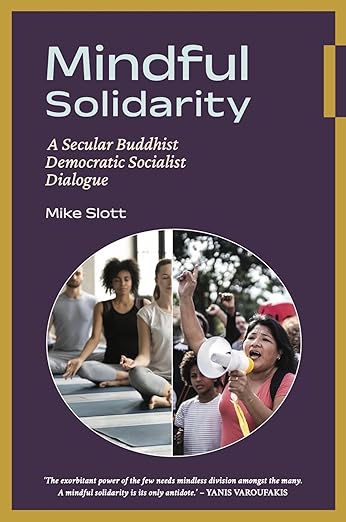
Mike Slott’s Mindful Solidarity: A Secular Buddhist Democratic Socialist Dialogue (Tuwhiri, 2024) lays out the arguments in favor of Secular Buddhism, why social engagement is necessarily a part of it, and how a Marxist analysis can complement the Buddhist analysis of suffering’s causes and amelioration. Mike is a long-time political and labor movement activist who manages the Secular Buddhist Network and edits its monthly newsletter, Rethinking the Dharma/Reimagining Community. He is a proponent of non-dogmatic and democratic forms of socialism. He believes Buddhism and radical political activism can benefit from dialogue with each other. Buddhists need to realize that not all causes of suffering are due to individual greed, hatred, and delusion; some result from structural causes rooted in class-based oppression and exploitation. On the other hand, radical political groups often splinter or flounder because members fail to recognize and minimize their egoistic involvement, or to employ mindfulness and compassion in managing intragroup conflict.
The book, like Mike, is earnest, thoughtful, humble, and humane. Mike lays out the reasons why he practices a secular rather than traditional form of Buddhism—a form that is naturalistic, pragmatic, and directed towards individual and collective flourishing rather than Nirvana. He thoughtfully discusses the work of other major Secular Buddhist writers like Stephen Batchelor and Winton Higgins, recognizing their contributions and sorting through areas of agreement and disagreement. He explores Jay Garfield’s ideas on “no-self,” and recommends not ontologizing it. He explains why the bodhisattva ideal might not be the best model for social engagement. He discusses convert Buddhist’s over-emphasis on meditation to the exclusion of other aspects of the path. He helpfully defines human flourishing through Buddhist and Marxist lenses, and also through the lens of Nussbaum’s and Sen’s capabilities approach. As you can see, this is a very rich book that covers a lot of ground.
So where do we agree, and where do we disagree? Like Mike, I practice a naturalistic, pragmatic Buddhism aimed at greater human flourishing. I agree that Buddhists should be socially engaged—that we have ethical responsibilities to do what we can to reduce suffering in our communities and on our planet. Finally, I agree that Buddhism lacks a sophisticated social theory—an analysis of how societies function, how they support exploitation and oppression, and how they can be improved—and that Buddhist theory needs to be supplemented by complementary approaches.
On the other hand, I believe that Mike is (at times, not always) more optimistic about human nature and how much we can improve society than I am. Mike believes that radical social change can greatly reduce the inequality and cruelty inherent in “neoliberal capitalism.” I, however, am a chastened liberal in the Niebuhrian sense. Reinhold Niebuhr’s Moral Man and Immoral Society (1932) is a profound exploration of social life that everyone ought to read. Niebuhr started out as a Marxist but gradually became disillusioned. He thought that individuals could aspire to be more moral, but societies were and always would be governed by power relations between competing groups. Elite groups never surrendered their privileges voluntarily, and subordinated minorities never gave up their demands without the threat or use of elite force. Social change came about through competition between elites, or from revolution from below; when revolution occurred, it established a new order in which the formerly ascendent and the formerly subordinated merely exchanged roles.
I‘m somewhat more sanguine than Niebuhr. Positive moral social change can sometimes occur—think of the successes of the abolitionist, suffragette, and gay rights movements over the past two centuries. But there is no guaranteed moral arc of justice, and what’s gained can easily be lost. It’s easy to imagine future dystopias in which nuclear war, climate change, biological plague, or waves of populist discontent erase all the positive gains of modern civilization.
Economic systems don’t stand apart from the societies they are an integral part of. The many institutions that make up our “economic system”—paper currency, the federal reserve, banks, stock exchanges, systems of credit, corporations, regulatory agencies, management theories, business law, unions—are institutions that took centuries to evolve, and they evolved in the context of other ongoing changes—the Protestant reformation, the scientific revolution, globalization, automation, the shift from a manufacturing to an information economy, the growth of secondary and post-secondary education, changes in family structure and the average life span, changes in communication and transportation, changes in medicine, changes in energy sources, changes in international relations, and so on.
All of these changes are interlocking, interconnected, and inter-affecting. While you can make changes in these systems—they are in fact changing all the time—every change one makes impacts how every other part of the system functions. It seems to be a rule that any solution to a problem is only a solution for a while until it too becomes a problem. Another rule is that every solution to a problem introduces new, unintended and unanticipated problems over time. So antibiotics, which solve the problem of infection, result in increased chronic diseases of old age. Automobiles which solve problems related to depending on horses for mobility (they go faster, don’t leave the streets covered in feces, and don’t tire out after twenty miles) create suburbs, smog, traffic jams, motor vehicle injuries and deaths, costly infrastructure needs, and climate change.
This means that when you are imagining “dismantling” and “replacing” capitalism, and think this will result in a better life, you are dwelling in fantasy land. Attempts to totally change societies (the French, Russian, and Cambodian revolutions are cases in point) are more likely to result in disasters rather than improvements. You are better off making small changes here and there—strengthening unions, changing taxation rates, subsidizing college tuition, regulating mergers and acquisitions, limiting predatory bank practices, amending corporate law, overturning Citizens United—than thinking in terms of “ending capitalism.”
In the long run capitalism will evolve into some new economic form of activity, just as feudalism and mercantilism evolved into new forms—but that will not be the result of planned change, just as no one planned to abolish feudalism, mercantilism, or hunter-gathering. What capitalism evolves into may be better or worse, but it will evolve.
In the meantime, let’s take a brief moment to appreciate capitalism. Under capitalism, the number of people living at the edge of dire poverty and starvation around the world has dramatically decreased, while the average human life expectancy around the world has dramatically increased. While poverty, racism, sexism, inequality, climate change, warfare, ecocide, nuclear proliferation, and the development of bioweapons continue as major unsolved problems, we might also note that poverty, inequality, social stratification, patriarchy, warfare, and many other ills have been true not just of modern neoliberal capitalist Western societies, but were also true of Babylon, Persia, the Athenian city states, the Roman, Russian, and Chinese empires, the Aztec, Incan, and Mayan empires, and any other large scale civilizations you can mention. Perfection is nowhere to be found.
I agree with those who suggest that the Scandinavian social democracies are preferable to the neoliberal society we have in Post-Reagan (and now post-Biden) America—that they are fairer, and the people there seem happier. I would love to nudge America in that direction. But as philosopher Richard Rorty noted—it’s easy to imagine better economic or social arrangements than the ones we have now. Almost anyone can do it. What seems impossible, however, is how to tell a believable story of how we can collectively get from here to there.
And remember that a lot of contemporary Leftist culture (antiracism, identity-based politics, calling out culture, pronoun policing, defunding the police, sanctuary cities, Occupy Wall Street, pro-Hamas campus demonstrations) has not resulted in intended improvements but has only served to help Donald Trump return to the presidency and threaten American democracy. The working class doesn’t seem to be on board with left-wing politics in America. Blame that on what you will— capitalist divide-and-conquer tactics, right-wing disinformation, infantile leftism—but the dream of a radicalized, united American working class seems further away than ever.
So, while I think we modern Buddhists need to be socially engaged, and that we ought to do what we can to increase the likelihood that more and more people can lead flourishing lives, I think we need to be careful. We needs to pursue practical improvements that have, given the current political climate, a reasonable chance of reaching fruition over an extended horizon of time. And then we need to empirically assess whether our “improvements” have actually ended up improving things or unintentionally making them worse. This is a liberal pragmatic program rather than a radical one.
Despite our disagreements, I’m glad I read Mike’s book. We agree on many points, and even where we disagree, Mike challenges me to think more clearly about where we disagree. Like Mike, I think Secular Buddhism has a lot to offer political activists. I hope this thoughtful and well-written book finds and serves its intended audience.
I tell often tell my fellow progressives: the point of activism isn’t to be heard. It’s to win. And winning often requires restraint.
I have a friend who is teaching at a university in South Carolina. He yearns to move to New York, for he is a fish out of water in SC. He says no matter where you go in South Carolina—a clothes shop, a diner, McDonald’s—there is a television in the corner, tuned permanently to Fox News. You can’t underestimate the role of propaganda in the current situation.
There’s also Thomas Frank’s book, “Listen, Liberal”, which an admonition to the left on how they abandon the working class, so that the Democratic Party is now the party of the university-educated professionals.
I’m glad I found this site. I’ve long read and benefitted from Zen stories Zen books, Zen philosophy. Finally, I thought I’d better go the full catastrophe and join a Zen sangha. I did. I suspended judgement for two and half years, but just this last December left, with due thanks to the roshi. All very nice people. All sincere. All quite flexible in terms of the formalities of practice. However, I couldn’t after while reconcile my deeply held values with what I saw there.
1. Sangha, but no community.
From crossing the threshold of the zendo to leaving, it was formality, formality, formality, bar 15 minutes of tea and chat at the end. After more than two years, I can’s say I really knew more than three or four of the forty or so members, and I couldn’t really say I knew them well. I also heard two members mention the fact that they were temporarily homeless. No reaction. No action.
2. Mimetic theory of intercultural learning.
Though the sangha did make certain motions to bringing Japanese Zen into tune with good Western values, it otherwise just copied Japanese forms. There were gestures—for instance “sin” was replaced by “harm” in one chant. “And women” at the end of a long list of dharma “heirs”. Chairs were made acceptable.
3. Feudal forms. Adopting Japanese forms necessitated adopting feudal forms: because that is the whole of the cultural millieux in which Zen was formed. Prostration. Altars. Lineage. Sanctification. Vows. Hierarchy. These are all feudal social forms.
4. Clinging to forms. It was clear that Zen in the West clings to these forms, in a way contrary to Buddhist teaching. I found recently that there was a movement in Japan, post-war, called Critical Buddhism, which made just this point. Apparently it made a dent.
5. No signs of generosity. I made a point that I didn’t feel comfortable making the roshi dependent on dana, unless we knew it was enough for his household. After two years they decided to give him a stipend… of $500 a month. This from a group that is always in financial surplus, with nett wealth that has grown to $200k. It just seemed both slow, and stingy.
6. No signs of fruit. Having been raised in a NRM, in which everyone was super nice, and dedicated to the ideals of their movement… but at the end of the day, their contributions to the world appeared to be neither more nor less than any other group of nice middle class people. I became also aware that the ideas of lineage and direct transmission made claims to “enlightenment” something extremely vulnerable to error, hope, and self-delusion.
7. Avoiding historical reality. Buddhism is not the religion of peace. During the whole of its existence in Japan, up to and including World War II, Zen was financially and politically allied with the Samurai class. The peasantry all practiced Pure Land. Zen even had “warrior monks” at one point. The Japanese army who carried out the rape of Nanjing were accompanied by Zen priests. Sri Lanka is charged with war crimes. Bhutan carried out one of the largest ethnic cleansing of the 20th century. Myanmar is on trial for genocide. Thailand has a regular purges of the Buddhist priesthood in response financial and sex scandals. Cambodia is ruled by violent kleptocrats who have dispossessed the peasants. Thailand and Cambodia periodically exchange lethal cannon fire over disputes of who owns which temple.
8. Not caring what others think. Pew did a survey of the world bigger religions between 2000-2010. They found that Buddhism was the only major religion to have shrunk in absolute terms, in that period. Moreover, I separately read that Zen in Japan is also declining, and is mainly in the business of funerary rites, no zazen. Why should one care? This meant that the next generation rejected it. The way I see it, each generation has the chance to see the one before with fresh eyes. I would take their rejection of the religion of their parents as a serious charge.
David, thanks for your comments. You might be interested in joining the Buddhist Coalition for Democracy (buddhistcoalitionfordemocracy.org) and see if that community is more to your liking. Mike Slott is the organization’s president. You might also find Mike’s Secular Buddhist Network on-line community more to your liking. It is based on Stephen Bathchelor’s approach to Buddhism.
I am sorry that your Zen community was not really a community. Not all Zen groups are like that—each one has its own personality. There are 84,000 Dharma doors. Keep looking until you find your own!